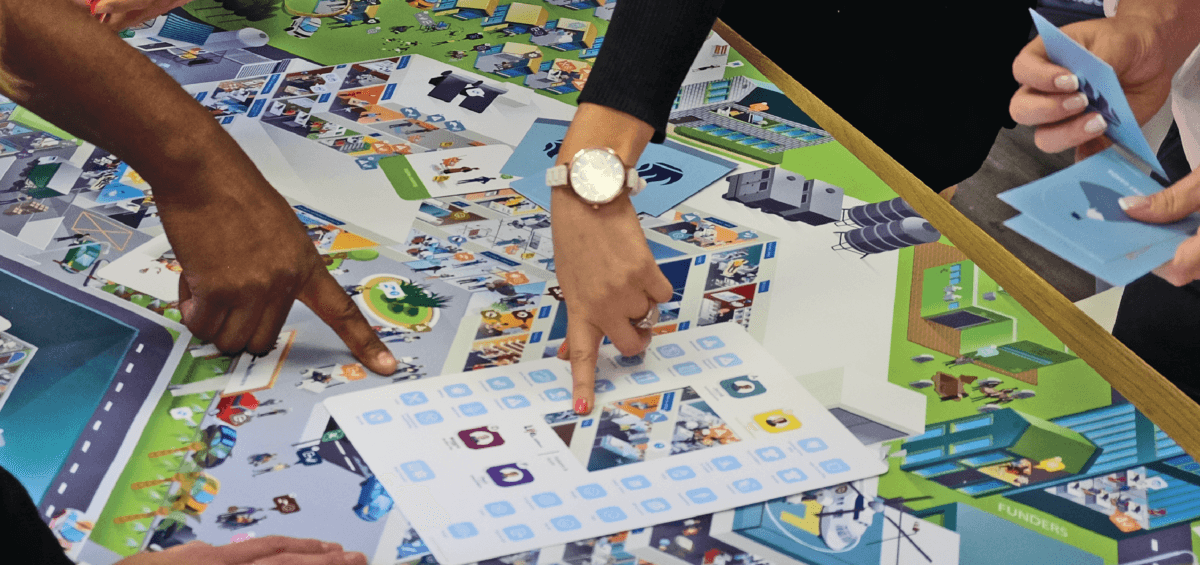
A learning map is a large, picture-based visual that guides a group of employees through a topic towards a clear goal, the way a map leads to a destination. Teams explore it together through discussion and self-discovery. Learning maps work for onboarding, brand engagement, change management, customer service, health and safety, strategy and process improvement.
Every business wants results in order to build and sustain a competitive advantage and keep the business moving forward. To achieve this, businesses should start by understanding that learning does not lead to sustainability but rather that learning is sustainability.
To get the best out of your business, you need to get the best out of your people. And, to do this you not only have to empower and inspire them by training and communicating with them in motivating and engaging ways but you also have to consider the unique way in which adults learn. Research on adult learning clearly showed that "adults in their daily lifelong learning normally learn from other adults. Persons with some limited literacy skills can help others in their group to learn literacy skills through participatory methods." (Rogers: 2002, p9)
This White Paper commences with a detailed discussion of Learning Maps. First, it defines a learning map emphasising the classic characteristic of a map: that it is directional with a clear goal. This is followed by a discussion of the importance of design. The section concludes with an analysis of the benefits attached to a learning map.
From there, the Paper moves on to discuss the seven ways in which learning maps will increase employee effectiveness. It highlights the fact that Learning Maps can be used as a learning solution for a variety of business challenges some of which include but are not limited to: onboarding and induction, brand engagement, change management, customer service touchpoints, health and safety hazards strategy, visualization, and process improvement.
At Trainiac, we use picture-based learning methods to develop learning solutions for the corporate market. At the centre of our solutions are Learning Maps that are developed to facilitate a 'reaction' and self-discovery in learning as well as to make the learning experience fun. Since 2001, Trainiac has successfully completed over 1000 corporate learning development projects for large leading companies and government departments.
What is a learning map?
A learning map is a large, illustrated picture of a whole subject, such as a business, a strategy, a process or a customer's journey, drawn as a single visual world with a clear destination. Like any map, it is directional: it shows where people are now, where they need to get to and the route in between.
A map is not a poster on a wall. Small groups gather around it with a facilitator and work through it together, prompted by questions rather than slides. Because people reach the insights themselves, in conversation with their colleagues, they remember them and act on them. Learning maps sit at the centre of Trainiac's picture-based methodology, alongside board games, card sets and illustrated tools.
Why the design matters
A learning map only works if people can see themselves in it. That means designing from the learner's point of view: one coherent metaphor, a consistent illustration style, and only as much detail as the conversation needs. Overload the map and it becomes a busy poster that working memory can't take in. Strip it back too far and it loses the story.
The facilitation matters as much as the drawing. Pairing a map with a structured facilitator guide lets your own people run the sessions consistently, time after time, without diluting the design.
The benefits of a learning map
- People discover the message instead of being told it. Insights people reach themselves are insights they own.
- Everyone sees the whole picture and their place in it. A map connects the big picture to each person's role.
- Pictures are remembered better than words. Visual information is easier to retain than text, which is why a single image can outlast a slide deck. See the benefits of visual facilitation.
- Dialogue replaces speculation. Exploring a map together surfaces questions and concerns in the room, rather than in the corridor afterwards.
- It works across languages and literacy levels. Pictures travel where text doesn't, so mixed groups can learn together.
7 ways learning maps increase employee effectiveness
1. Onboarding and induction
New joiners decide early whether they'll stay, and much of that decision depends on whether their first weeks deliver on the promises made during recruitment. Instead of a policy pack, a learning map captures your organisation's story, culture, values and strategy in one visual world. New joiners explore it through guided conversation and find where they fit. That sense of "I can see where I fit" is what turns a new hire into an engaged, productive employee sooner. More on induction and onboarding.
2. Brand engagement
Employees can only deliver a brand promise they understand. A learning map turns your brand, from what it stands for to what customers should experience and how each team brings it to life, into something people can see and discuss rather than a set of words in a guideline. When employees can explain the brand in their own words, they are far more likely to live it in front of customers.
3. Change management
People don't resist change. They resist change they can't see the point of. A change learning map gives the transformation a shared visual story: where we've come from, why we can't stay here, where we're going and what the journey asks of each of us. Explored in facilitated dialogue, that picture replaces rumour and anxiety with understanding, so change becomes something people walk through together. More on change management.
4. Customer service touchpoints
Every employee shapes the customer's experience, but people far from the customer often can't see how their work affects it. A touchpoint map lays out the customer's whole journey, front line to back office, so every team can find themselves on it and see exactly where their behaviour lands. When people see the consequence of a dropped handover, the conversation shifts from "that's not my job" to "that's my customer". More on customer experience.
5. Health and safety
Safety rules are easy to recite and easy to ignore. A learning map of your own workplace makes hazards visible where they actually occur, and shows what safe behaviour looks like at each point. Teams talk through the risks they face every day, which turns safety from a checklist into a shared responsibility. The same approach makes compliance training more engaging.
6. Strategy visualisation
Most strategies don't fail because they were wrong. They fail because they never left the boardroom. A strategy learning map shows your market, your challenges, your choices and what success looks like on one canvas. Teams explore it together and answer the question every employee silently asks: "What does this mean for me?" Because they reach the answers themselves, they own them. More on strategy alignment.
7. Process improvement
A new system or process only improves performance if people adopt it. A learning map shows the "why" before the "how": where the organisation is heading, why the old way can't take it there, and what the new process makes possible. With that understanding in place, scenario-based practice equips people to work the new way confidently from day one. More on system and process adoption.
Where to start
Each of these is a gap between what people know and what they understand. Pick the one standing between your people and your goals, and tell us about it. We'll show you what a learning map for it could look like.